Thursday, April 20, 2023

IRREGULAR VERBS QUIZ AND PRONUNCIATION


LEAD IN / Warmer : 


Can you read the following words :


           “There is no elevator to success. You have to take the stairs.”- Unknown Author


    There are 3 columns of Irregular Verbs in English that are used in accordance with one of each of the 12 tenses : 


    Example :

    1st/Present : eat

    2nd/ Past : ate

    3rd /Participle : eaten


    Choose the correct form of the verb for each sentence:


    1. Have you ______________ your lost dog yet?


     find  found


    2. She spoke too softly. I couldn't ______________ her.


     hear  heard


    3. But we heard everything she ______________ .


     say  said


    4. We went shopping and I ______________ a new pair of jeans.


     buy  bought


    5. Did you ______________ well last night?


     sleep  slept


    6. I used to ______________ a lot of money, but I don't make much now.


     make  made  


    7. We were really surprised when we ______________ the game.


     win  won


    8. We thought we would ______________ for sure.


     lose  lost


    9. Have you ever ______________ a movie star?


     meet  met


    10. Mum taught our sisters how to cook, but she didn't ______________ us.


     teach  taught


    Mini Quiz


    1. The past simple (V2) and past participle (V3) forms of irregular verbs are _______ different.


     never

     always

     Often


    2. "Our athletes ran, swam, jumped, fought, rode bikes and played team sports." How many of these verbs are irregular?


     three

     four

     Five


    3. Complete with the correct form of the verb: "Have they _______ home yet?"


     go

     went

     Gone


    …………………………………………………………………………………


    Irregular Verbs - Past Participle 

    1) She has never 

    (let) her daughter have a boyfriend.


    2) Have you already 

    (read) today's newspaper?


    3) The house has been 

    (sell).


    4) He has 

    (lose) his wallet again.


    5) I have 

    (write) three essays this week.


    6) That clock was 

    (make) in Switzerland.


    7) He had 

    (run) 6 miles when he hurt his ankle.


    8) I have never 

    (see) such a beautiful view.


    9) He has 

    (teach) hundreds of students during his career.


    10) Have you ever 

    (meet) a famous person?


    11) Because she hadn't 

    (pay) the bill, the electricity went off.


    12) They have 

    (send) Christmas cards to all their friends.


    13) Where have we 

    (put) the car keys?


    14) We have never 

    (sing) in public before.


    15) She had 

    (wear) her blue dress many times.


    16) John had never 

    (speak) English before he came to London.


    17) Why have you 

    (stand) up - are we leaving?


    18) Have you ever 

    (swim) in the Atlantic Ocean?


    19) It had 

    (take) three hours to reach the station, so they had missed the train.


    20) I have never 

    (say) that I didn't love you.


    21) David jumped into the air. He had 

    (sit) on a drawing pin.


    22) The weatherman had 

    (tell) us it would be sunny, but it rained all day.


    23) I'm sorry I'm so tired. I haven't 

    (sleep) .


    24) Have you 

    (think) about changing jobs?


    25) He'd thought he had 

    (understand) but now he realised he'd made a mistake.


    Tuesday, February 14, 2023

    FREE LESSON : The evolution of technology


    Let’s do a short quiz to test your knowledge of gadgets from the 90s and then follow that up with some vocab acquisition and a video about predictions made by children in the 60s. You may well be rather surprised at their eloquence and accuracy ! 

     The evolution of technology :                         


    Lead in : 

    • Which gadgets do you depend on most ? 

    • What would you do if you lived alone and all of your equipment kicked the bucket ? Your mobile phone, laptop and the wifi went down ? Any advice for others ?

    • What are some of your pet peeves about technology 

    • In which ways has technology improved or worsened your quality of life ? 


            How familiar are you with gadgets from the 90’s ? 

                                 Let’s test your knowledge ! 

                           Warmer : Quiz time !


    Test your knowledge of these gadgets and facts from the 90’s


    1.Google officially launched in 1998, but what was the search engine originally called?

    NeckMassage

    BackRub

    BackItch

    HeadAche

    Gogglebox


    2.The first commercial mobile phone, the Motorola DynaTAC, was discontinued in 1994. How long on average did it take to charge the phone?

    10 Hours

    9 Hours

    8 Hours

    11 Hours

    Twelve centuries


    4.What is this?

    Xbox

    A popcorn maker

    GameBoy Color

    Playstation One

    Sega Dreamcast


    5.What was this device called ? 

    A flip around phone

    Your granny's hair dryer.

    A rotary device

    A rotary phone


    6. What were the Yellow pages ?

    Your granny’s journal

    Your auntie’s hair curlers

    A book of addresses, numbers and names


    7.Listen to this sound up to ) 0 : 20 seconds : https://www.youtube.com/watch?v=GSRG0TqxLWc 

    What device produced this particularly stressful sound ? 


    Check the vocabulary box, then let’s drill any tricky pronunciation ! 


    1. Dull /tedious: Mundane, boring, not at all entertaining.

    2. Rations : To be limited in what one can purchase or own.

    3. Oblivion : destruction or extinction. To be completely destroyed, in the depths of struggle.

    4. Automation : a term for technology applications where human input is minimised. This includes business process automation (BPA), IT automation, personal applications such as home automation and more.

    5. Batteries ( As regards animals ) : (British English) ​a farm where large numbers of chickens or other animals are kept in very small cages or crowded conditions

    6.  To yield : produce or provide (a natural, agricultural, or industrial product). "the land yields grapes and tobacco"

    7. Drastic : likely to have a strong or far-reaching effect; radical and extreme. "a drastic reduction of staffing levels"

    8. Grapple : struggle to deal with or overcome (a difficulty or challenge).


    • Pick one or two of the vocabulary items and make some examples ! 


    Now, let’s watch the video on children from the 1960’s making predictions about the future  and then let’s chat :

    1. What is the young boy’s prediction about the year 2000? Was he far off ?

    2. The young girl predicted what food may be on offer - what do you think? A tad far out ?

    3. What did the second boy mention about atomic bombs and the world as we know it ?

    4. True or false : The world will become so overpopulated that ‘’population control’’ will have to take place through drastic measures.

    5. The planet will become so hot ( global warming ) that there will no longer be any life on the earth. What are your thoughts ?

    6. ‘’I don’t think there will be an atomic war, though automation will take over jobs and I think something has to be done about it.’’. Do you agree ? Is it happening now ?

    7. What does this expression mean : To temper the population problem.

    8. Do you agree : ‘’Things would be awfully dull and people will all be squashed together, there won’t be any fun. People will be rationed for the amount of things they can have.’’

    9. ‘’I think it will be boring. People will be the same. Inauthentic.’’

    10. First of all, computers are taking over now.  Computers and automation. In the year 2000 there just won’t be enough jobs to go around. Did this happen or do you reckon it may well happen in future ? 

    11. ‘’People will have to live in flats piled up on top of one another due to an increase in population. ‘’ Is this something prevalent in this day and age or do you disagree ?

    12. Animals/livestock will be kept in batteries, no longer allowed to graze on pastures. The purpose is to yield more food for an overpopulated society. Is this necessary or not ? Does this happen in your country ? 

    13. ‘’There will no longer be racial division in the future.’’ Was the girl’s prediction accurate ? 

    14. Which of the predictions were most surprising ? Take a moment to think : What are some of your own predictions ? 


    Part 2 : 

    Fill in the gaps : Remember to make notes as we go along ! 

    • Dull/tedious

    • Rations/rationed

    • Oblivion

    • To yield

    • Batteries

    • Automation

    • Drastic

    • Grappling 


    1. Maybe we should try something less______ first. We certainly do not need to take such serious measures !

    2. Children predicted that animals would live in ______ and not be free to roam fields and live outdoors.

    3. One of the children stated that food would be ____. I feel that this is true/ not true due to the fact that _____. ( Opinion ) 

    4.  Life could possibly become quite _____ if one limits oneself to playing computer games and spending too much time indoors. 

    5. In future, if climate change has more of an impact, the land will _____less produce and we may well have to ration what we consume.

    6. It is said that ____ is going to make many jobs redundant. I do / do not believe that we will be able to adjust with the times.

    7. If we do not take care of our planet, we may face total ______. Extinction of animals and a dramatic shift in climate globally.

    8. Robotics/automation is said to have been a great help for countries such as Japan, who are ______ with a population decline and shortage of blue collar workers.


    Questions to discuss : 

    1. How has technology helped you with language learning?

    2. Can you name/ think of some gadgets that we use everyday? What technological item could you not do without?

    3. What are some negative and positive aspects of using technology as a study tool? ( Dangers of technology.)

    4. Have you thought of taking a social media detox lately ? 

    5. What do you do to recharge your batteries instead of spending a drastic amount of time online ?

    6. What are your thoughts on automation ? Will there truly be fewer job opportunities for people ? 

    7. ‘’South Korea is one of the top automated countries in the world. This AI country is focused on having the highest robot density in the manufacturing industry that can cover the workload of 15 full-time human employees.’’ - What do you think of this ? Do you find automation a tad scary ? Why or why not ?

    8. Birth rates/natality rates have declined in countries such as Japan so it is said that fewer people feel threatened by automation. Is this the same situation in your country ? 

    9. If you could invent a robot  / machine that could make your life easier, what functions would it have ? 


                        Extra reading / Links : 


              1 HOUR BEST OF '80s & '90s MUSIC | Karaoke with Lyrics https://www.youtube.com/watch?v=nhBqryez_Zw


    Can You Remember The 90s? Prove It! Take This Fun Trivia Quiz Test

    https://www.youtube.com/watch?v=7YK7F8UB5aU


    https://www.zoo.com/quiz/only-1-62-people-can-recognize-all-these-90s-tech-gadgets-can-you


    https://www.globalxetfs.com/japans-robot-dominance/


    Saturday, April 30, 2022

    Essential and fun vocabulary for eloquent articulation. Part 2 :


    Adept: (Adjective | noun) - Expert, skilled and proficient at something, someone who is proficient at something.

    Synonyms: Skilled, gifted, talented, expert at something, master.

    Examples :

    In order to be adept at language, one needs to practise regularly.

    He is most adept at playing the guitar - do you know that he is self - taught ?

    Venerate: (Verb) - Revere, regard with respect.

    Synonyms: Revere, idolise, honour, esteem.

    Examples :

    The young generation venerates pop stars and reality show stars, oftentimes mirroring their fashion sense.

    Our veneration of world leaders is on a speedy decline.

    Invoke: (Verb) - Pray to, appeal to, call on someone as a witness for inspiration, solicit, cite, refer to.

    Synonyms: Conjure up, adjure, summon, implore. 

    Examples :

    After the publishing of conflicting views of the vaccination, negative impressions have been invoked - many refuse to be vaccinated. 

    The pandemic and restrictions have invoked a plethora of negative consequences for many who are just trying to get by. 

    Myriad: (Noun/Adjective) - A large, a great number of.

    Synonyms: Multitude, innumerable, countless, numerous, a lot, mass, army, horde, a large number quantity.

    Examples :

    There are a myriad of people who have excellent communication skills in English even though they have never been to an English-speaking country.

    There are myriads of people in the hospitality industry who have had to shut doors due to the lockdown.

    Salient: (adjective) - Most noticeable and important, major, main.

    Synonyms: Important, principal, chief, primary, notable, prominent, remarkable, pivotal, vital.

    Examples :

    A salient feature in pursuing higher education in a foreign country is the attainment of an excellent band score in the IELTS exam. 

    One of the salient and positive features in the ever growing demand for online English lessons, is (alongside of being able to study with a native English teacher ) accessibility to the masses. 

    Substantiate: (Verb) - Prove, support, give proof of, confirm.

    Synonyms: Affirm, justify, validate, verify, prove something, support.

    Examples :

    The evidence substantiates why the wealth gap is not conducive to a sustainable economy.

    She has nothing to substantiate her brash decision to end all communication so unfairly. 

    English listening skills/ how to train your ear : Part two :


    Hearing is different from active listening - hearing is merely the act of recognizing sound ( hearing a loud bang or birds chirping outside - this requires no effort.) whereas listening is taking in information, understanding the vocabulary, expressions and nuances of a language so as to comprehend what is being said - so as to COMMUNICATE effectively. Hearing is called signal-based processing. Listening requires both an active effort, a basic understanding of the English language and hearing. Exemplary English listening skills are essential to deep and meaningful conversations, essential to communicating and forging solid relationships. Essential to your passing that exam or job interview with flying colours !

    So, what can we do to start fine - tuning this magnificent skill, you ask...well : Continue reading : 

    Try these 3 exercises to train your listening skills:

    1. Watch a show on Netflix or your mobile phone without closed captioning/subtitles, playing it back with closed caption/subtitles to evaluate how well you understood everything that was happening. Try doing this in short segments - 10 minutes or 15 minutes. 

    Make notes of full expressions that you may not yet understand/that are unfamiliar. ( Remember - jotting down individual words is not always helpful as we have idioms, phrasal verbs and certain expressions in English that can not be separated. Examples : Raining cats and dogs, Kick the bucket, How are you holding up?) 

    Make notes of any elisions / contractions that were not clear in spoken English but understood once reading the closed captions. 

    Examples : 

    • Would you like a cup of tea >>>Wood’yeh’lyk’eh’cuppeh’tei ? (Elision/Connected speech and the Schwa sound. Contact me for more information on the schwa sound and why it is essential to English pronunciation. ) 

    • What are you doing >>>Whaddaya’doin? ( Elision/Connected speech.) 

    • Are you British >>>Ah’yeh’Brih’ish ? (Example of ‘’T’’ Glottalization - where the ‘’T’’ is often dropped. Contact me for a lesson if you would like more information on the rules and how to produce this sound ! ) 

    This will help you highlight some of the typical nuances of pronunciation when natives speak. Being able to produce these sounds will help you recognise them when you hear them ! This will greatly improve your pronunciation and listening skills ! 

    2. When you have started to feel comfortable doing exercise one, read a book whilst simultaneously listening to the audio-book version. ( Graded readers are available online ! Try reading a book specifically for your level and then read the same book just a level higher. Intermediate >>> then Upper Intermediate ! )

    3. Read the news aloud/ Get a friend or your partner to read it aloud to you -  then rephrase what you heard / discuss the news article. ( Remember to jot down new vocabulary as you do this ! A large part of struggling with listening/comprehension is simply because one has encountered new vocabulary. ) 

    Interested in the 5 features of connected speech ? The Schwa sound or the glottal stop ? Pop me a message and let’s have a lesson ! :) 

    Remember, cultivating good habits is essential to your progress. Motivation alone will not serve you - one needs to be dedicated and disciplined. Start off with 10 minutes once a week if you do not feel the discipline fairy in your soul ! Then… 20 minutes...then...45...then 60 ! You can do this !

    English Listening skills/ how to train your ear - Part one :

     How can you improve your listening skills, you ask ? Read on !!! I have some advice for you...and I do so hope that you find this mini lesson helpful.


    Practice is essential as we all well know. One has to be disciplined and put in effort/make an effort... You do not have to spend hours each day in order to improve. Start with ten minutes per day and devote those minutes to listening to a short clip, the news or watching a short film. Try not to cram ( Do too much.) , essentially - you want to practice just a bit - each day.  Do your future self a favour ! Start now. Listening to clips two or three times a week will not help - again : what we do daily, essentially matters most. Cultivate good habits.

    Bad habits are easy to create - why not nurture healthier habits? 

    Here is a fabulous link to get you started:

    https://www.englishlistening.com/listen

    Why this website ? Well, all activities are filtered by accent, levels and topics - you are also able to choose the speed of speech. ( Most helpful for lower level learners / if you are starting out with practicing your listening skills. ) Try a free trial and see how you feel ! You may well like it !

    Free listening practice : 

    http://www.elllo.org/


    Let's begin :

    English words confer meaning based on whether they are content or function words. Knowing the difference will help with both understanding and pronunciation:

    Content words = Provide us with mental pictures /images - information, meaning


    Function words = necessary words for grammar


    Function words : purely there for grammatical purpose - such as : Articles ( a, an ,the), Prepositions ( at/in/over.) , Auxiliary verbs ( do, has, will etc.) and Pronouns ( He, she, ours etc.) 

    Content words :  conjure up an image /a mental picture of something such as Adjectives/Nouns/Verbs and Adverbs

    NOTE:

    Content words are always stressed = enhanced/spoken louder whereas function words are glided over. 

    ( This is apart from word stress itself where for example, words of two syllables : a noun is stressed on the first syllable and a verb, on the second. Eg: NOUN: OBject / Verb: obJECT.) 

    See more about word stress: 
    http://www.english-at-home.com/pronunciation/noun-and-verb-syllable-stress/


    Let's try to practice : Read this aloud: 

    The man ate the apple while sitting at the sea, it was a beautiful day and he was content !

    Which words did you say louder ? Which words give you a mental image?

    Can you point out the content words ? Which words do you think provide a word picture ? 
    ( Remember : Nouns, main verbs, adjectives and adverbs are usually content words. Auxiliary verbs, pronouns, articles, and prepositions are usually function/grammatical words.)

    Now, read this : Man ate apple sitting sea, beautiful day -  content ! 

    ( We are still able to understand the meaning/gist of what is being said - this is why content words are spoken louder - they are the most important because they convey the message to our listener.) 

    Tip when listening /watching movies : 

    Start watching films with subtitles - this will help fine tune your ears to naturally spoken English. By following with subtitles - you will understand better when the following happens:


    • Contractions ( It is = It's/ They are = They're/What is = What's.)  

    • Varied accents ( i.e : American vs British/ Regional dialectical accent.)  -  where more elision/linking is used.


    Examples of linking: What are = whaddah / could have = couldiv / where are you going / wherayagoin ? A lot = ahlod

    Two main types of linking:

    consonant ⇔ vowel
    We link words ending with a consonant sound to words beginning with a vowel sound.
    vowel ⇔ vowel

    We link words ending with a vowel sound to words beginning with a vowel sound.


    How do I improve? You ask... well = more listening ! 
    Instead of listening to English “when you have the time”, do it whilst driving home, cleaning the house or a few minutes each day before bed ! Download podcasts on your mobile phone - easy as pie ! 
    Take a lesson or ten with me ! :) :) :) Movies with subtitles and short films are also reasonable. You have to do the work and train your ear ! Trust me, in time - it gets easier and soon, you will be able to get used to the way native speakers ''run through'' sentences. 


    LET'S PRACTICE :

    Try this exercise sourced from ThoughtCo.com :

    https://www.thoughtco.com/

    Exercise

    Decide which words are function and content words in the following sentences.

    • Mary has lived in England for ten years.

    • He's going to fly to Chicago next week.

    • I don't understand this chapter of the book.

    • The children will be swimming in the ocean this time next week.

    • John had eaten lunch before his colleague arrived.

    • The best time to study is early in the morning or late in the evening.

    • The trees along the river are beginning to blossom.

    • Our friends called us yesterday and asked if we'd like to visit them next month.

    • You'll be happy to know that she's decided to take the position.

    • I won't give away your secret.

    Check your answers below:

    Exercise Answers

    Content words are in bold.

    • Mary has lived in England for ten years.

    • He's going to fly to Chicago next week.

    • don't understand this chapter of the book.

    • The children will be swimming in the ocean at five o'clock.

    • John had eaten lunch before his colleague arrived.

    • The best time to study is early in the morning or late in the evening.

    • The trees along the river are beginning to blossom.

    • Our friends called us yesterday and asked if we'd like to visit them next month.

    • You'll be happy to know that she's decided to take the position.

    • won't give away your secret.

    Manners : Polite expressions in English :

     “Life is short, but there is always time enough for courtesy.” ― Ralph Waldo Emerson


    Generally speaking,  people value being polite and respect good manners. A golden tip is that it is essential to utilize the three magical words of politeness in English :  “Please”, “Thank you,” and “Excuse me”.

    Often, it is easy to simply say : ''What?'' as opposed to ''Excuse me?'' - my advice is that one should try to cultivate good habits through grading your communication style. 

    • What kind of language do you use when something is unclear / when you do not understand the question or statement ? 

    When something is unclear or you misheard - ''What!'', is inappropriate - instead, simply say : 

    • ''Pardon me, I did not get that...''

    •  ''Excuse me, I do not think I understood.'',

    • ''Sorry, but could you repeat that ?''

    It is common practice to say, ''Thank you.'' after your request has been fulfilled. 

    Image result for being polite modal verbs


    ADDITIONS: 


    Ways to politely message someone for clarification/ if someone is late or to verify an appointment date/time:

    1. Hello______. ( name ) How are you? I was just checking to see that all is well. Are we still meeting at ____ ( time of appointment) today? Thank you so much!

    2. Hi there. I hope that all is well. I am just messaging to let you know that I am online/ available/ ready for our appointment, I am looking forward to our meeting!


    3. Good day_____(name of person). I trust that you are well! I am so looking forward to our chat/meeting/ appointment at ____ (time), I am online and ready when you are. See you soon!

    4. Hi _____(name). I see that you are not yet online, I hope that we have not confused the day/time of our meeting. Please do pop me a message just to verify that we have the same slots scheduled. Thank you!


    Moving on, it is best practice when making an appointment, a reservation, scheduling a meeting and even requesting something from your teacher - to say/ use one of the following:  

    • ''Please..........Thank you.''

    • '' Would it be possible to___________.''

    • ''May I please_________.''

    • ''Could I arrange________. Thank you.''.

    • I would like to _________ Thank you so much !''

    Polite language goes a long way and will help you avoid any misunderstandings ! Notice how in English we use modal verbs such as ''could, would, May'' when making a polite request.  Being polite will make certain that service providers and co - workers want to help you with what you need ! 

    Speaking tip: could and can are followed by the verb without to. 

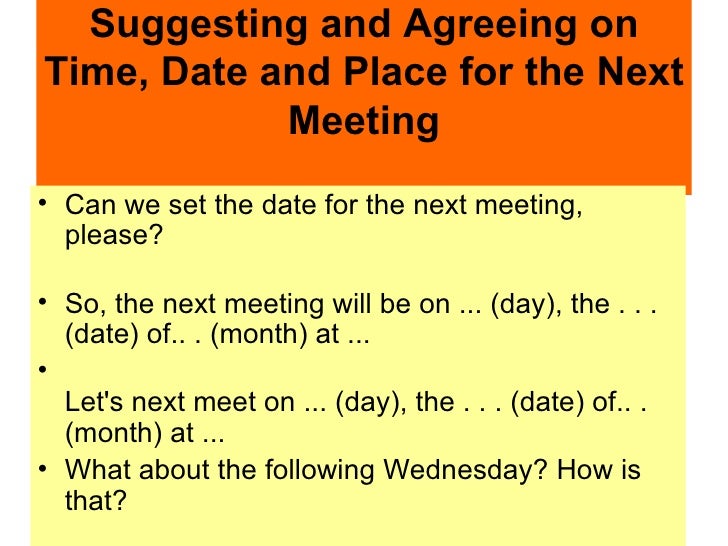
    Image result for providing meeting times i english

    When you would like to schedule a meeting, it is essential to provide a few days and times, so that everyone is able to fit into your time slot/ agenda. Some useful language:

    • '' Would it be possible to meet on one of the following days:________''.

    • ''I would like to schedule a meeting/ book an appointment - would one of the following days be suitable at ________ time?'' ( Provide days.)

    •  '' How are you? / I trust all is well? I was wondering if we could move our appointment to another day - how about one of the following days:_________.'' ( In some cases, especially with regards to English lessons - regular classes are a prerequisite to improvement, so - rescheduling after a missed class is wise and fair for both the teacher and yourself ! )

    •  ''I can not make it today because _____, could we meet later this week - maybe on __ ( provide day.) or _____( provide day.) at ________( provide a few times.)